The Unseen Hours: A Home Capsule for Rest Days
A capsule wardrobe is usually judged by what leaves the house: the coat that survives a wet commute, the trousers that work for a meeting, the shoes that can be walked in for a mile. The hours spent indoors are rarely part of the calculation. Yet for many people, those are the hours when the wardrobe is most visible to the person wearing it. Home clothes are not a minor category. They are the clothes of recovery, of ordinary evenings, of the quiet Sunday before the week begins.
This is where good intentions often thin out. Workwear is planned; homewear is inherited. The drawer fills with old gym tops, free T-shirts from events long forgotten, half-mended joggers and the jumper kept only because it is too soft to discard and too shapeless to wear outside. None of it was chosen. It was simply retained. The result is a familiar complaint, usually voiced at the end of a long day: nothing to wear. It rarely means there are no clothes. It often means there is nothing to wear at home.
The drawer that escapes the audit
A considered wardrobe tends to have a front door and a back door. The front door is where outfits are assembled, reviewed and worn in public. The back door is the drawer, the hook behind the door, the pile on the chair. It is the place where standards are suspended, not out of laziness but because the category has never been named. Once named, it becomes easier to edit. Home clothes deserve the same calm attention as a winter coat, even if the attention is smaller and more private.
A home capsule is not loungewear as a trend, nor is it activewear repurposed for the sofa. It is a small set of clothes kept for rest, domestic tasks and the unglamorous parts of the day. It should be comfortable enough to sit, cook, read and sleep in a chair. It should be tidy enough to answer the door or receive an unexpected delivery. It should suit a British indoor climate, which is rarely one climate at all. A terraced house may have a warm kitchen and a cold back bedroom; a flat with radiators may still suffer from draughts. The home wardrobe has to work across both.
A small list, deliberately kept small
The aim is not to create a second wardrobe of equal size. It is to create a drawer and a shelf that can be understood at a glance. For most people, five categories are enough.
- Two pairs of soft trousers. Look for cotton twill, brushed cotton or a wool blend with a clean line. An elastic or drawstring waist is practical, but the leg should not be so loose that it feels like sleepwear. Charcoal, navy or oatmeal will sit with everything else.
- Two knits. One fine merino or lambswool crew neck and one cardigan or zip-through layer. The knit should be warm without being bulky, and soft enough to wear against the skin if needed.
- Three long-sleeve cotton tops. These are the base layer for cold mornings and the only layer for milder ones. A slightly thicker jersey is more useful than a thin promotional T-shirt.
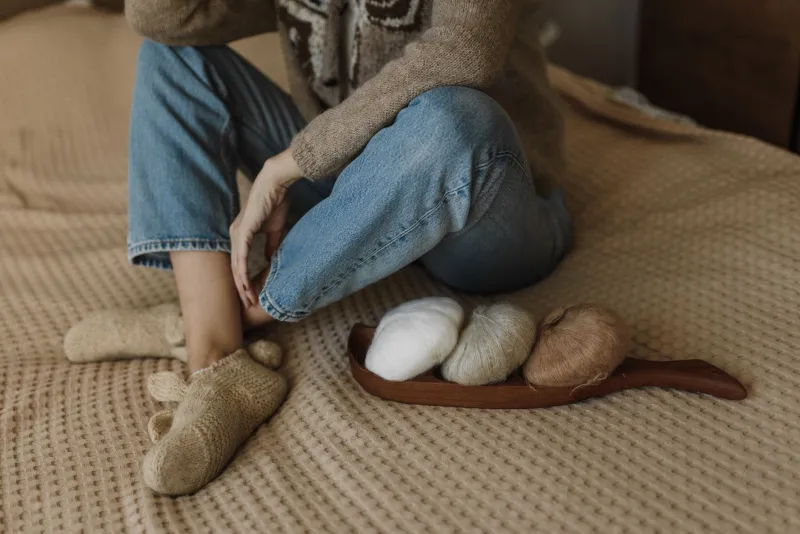
- Warm socks. Wool blends are worth the small extra cost. Have one pair for everyday indoor wear and one thicker pair for the coldest days.
- One house shoe or slipper with a proper sole. This is the piece that separates rest from drift. A sole means the wearer can step into the garden, take out the bins or meet the postman without changing shoes.
An optional overshirt or quilted gilet can be added for draughty hallways, but it should not become a reason to expand the drawer indefinitely. The home capsule works because it is finite. It is a uniform for the unseen hours, and like any good uniform it removes a small daily decision.
Fabrics for British indoors
British homes are not uniformly warm, and the central heating is rarely set to a constant ideal. A home wardrobe therefore needs layers that can be added and removed without fuss. Merino wool is particularly useful: it regulates temperature, resists odour and can be aired between wears rather than washed after every use. Lambswool is warmer and slightly more rustic, better for a cardigan than a base layer. Cotton jersey is the workhorse of the drawer, provided it is thick enough to hold its shape. Brushed cotton is excellent for trousers in winter, though it should be washed with care to avoid pilling.
Heavy fleece and thick synthetic loungewear can be tempting, but they often overheat in a heated room and feel damp after activity. Delicate fabrics that require dry cleaning have no place in a home capsule; the point is ease, not maintenance. The best home clothes are those that can be worn, aired, washed and repeated without anxiety.
The edit
Begin by emptying the home drawer onto the bed. This is not a sentimental exercise. Keep only what fits, what is comfortable and what has no holes, no scratchy seams and no need for constant adjustment. Remove the free T-shirts with slogans, the old gym tops that have lost their shape, and the items kept only because they were once expensive. If a garment is too worn for the house but too useful to discard, it belongs in the mending basket or the textile recycling, not in the daily rotation.
Sleepwear should be kept separate. It is a different category with different requirements, and mixing the two is how the drawer becomes confused. Sentimental pieces can be stored elsewhere if they are not worn. The test for the remaining items is simple: would you be content to answer the door in this? The answer does not need to be formal. It needs to be composed.
A quiet standard
Dressing for nothing in particular is still dressing. Rest is not an absence of life, and the clothes worn during it do not need to be performative. They need to be suitable. A good home capsule makes the evening feel less like a collapse and more like a deliberate pause. It reduces the low-grade friction of wearing clothes that are uncomfortable, shapeless or simply not chosen. It also protects the outside wardrobe, keeping good knits and trousers away from cooking splashes and long afternoons on the sofa.
There is no audience for this part of the wardrobe, which is precisely why it matters. Quiet luxury is not a price bracket; it is a standard of care. At home, that care can be very small: a pair of trousers that fit, a knit that is warm, socks that are not thin at the heel. The unseen hours deserve a considered drawer.