The Small Bag Test: What a Single Night Away Reveals About Your Wardrobe
Photo: small tan leather overnight bag packed with folded clothes on bed natural light minimal, via www.fourpaws.com
The bag as a test, not a category
A one-night trip by train is a more exacting test of a wardrobe than a fortnight abroad. Long holidays tolerate padding: the extra knit, the second pair of shoes, the tablet that might be read. A single night away does not. The bag must be carried onto a platform, lifted into an overhead rack and opened in a small hotel room without becoming a portable wardrobe of maybes.
The overnight bag is therefore not a separate category of clothing. It is a sample of the main wardrobe, taken under pressure. The question is not what to buy for travel but whether the pieces already owned can form two credible outfits, meet the British weather and leave room for a toothbrush. If they cannot, the fault is rarely the bag. It is the edit behind it.
Two outfits, one bottom
The most useful formula for one night away is not two complete changes. It is one set of trousers, two tops, one mid-layer and one outer layer. The trousers are worn on the journey and rested overnight. The first top travels under the coat. The second top is packed flat for the evening or the return journey. This is enough for dinner in a modest restaurant, a night's sleep and the train home.
A common error is to pack by category rather than by outfit. Two shirts, an extra cardigan and a spare pair of trousers may each seem reasonable in isolation, but together they create options without a plan. Packing by outfit forces a decision: the dark trousers work with both tops, the knit sits between them and the coat finishes the whole. Nothing in the bag is waiting for a role.
For a November journey, a fine merino crew neck and a cotton shirt are a sensible pairing. They regulate heat on a carriage that is often warmer than the platform. A scarf provides the change of tone that a second jacket would otherwise supply. The aim is not austerity for its own sake but coherence: every item should have a reason to be present.
Weather-ready without a second bag
British weather in late autumn rarely asks for specialist gear. It asks for layers that can be removed and replaced without fuss. The coat should be the bulkiest item and should be worn, not packed. A shower-resistant wool coat or a trench with a warm mid-layer beneath will handle a cold platform, a drizzle and an overheated train carriage. An umbrella belongs in the bag only if it is small and genuinely used.
The layer removed on the train is the layer put back on at the station. This simple rhythm prevents the bag from filling with contingency clothing. A thin knit, a scarf and a coat are usually sufficient. The traveller who packs a second coat for a change in weather is often carrying anxiety rather than practicality.
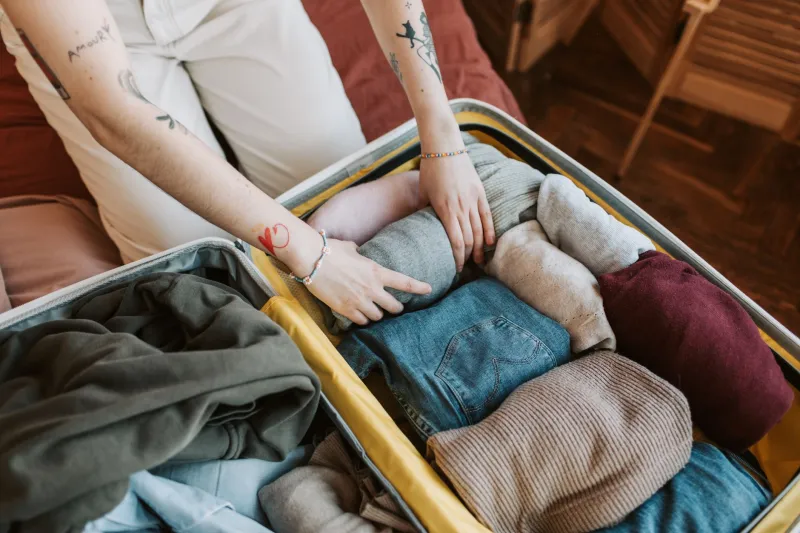
Care also belongs in this calculation. Folded knitwear should be rolled rather than stretched; shirts should be folded along existing seams; shoes should be kept away from light fabrics in a cloth bag. A small bag protects clothes only when it is packed with the same attention given to their washing and storage at home.
One pair of shoes, chosen for the whole journey
Shoes are the decisive item. They are heavy, bulky and difficult to improvise. For one night away, one pair is enough if it is chosen for the entire journey rather than for a single moment. A dark leather ankle boot with a low heel will walk to the station, sit under a restaurant table and meet the return train without demanding a second pair.
Trainers can serve the same purpose if they are clean, dark and broken in. The point is not formality but consistency. If the trip genuinely requires a second pair, it is not a one-bag trip. That is a useful distinction, not a failure. It keeps the overnight bag honest.
The pre-departure check
Before the bag is closed, a short checklist is more effective than a long one. Confirm the forecast and the journey. Lay the worn outfit and the packed outfit side by side. Remove one item that has been added for an imagined occasion. Decant toiletries into small containers. Place tickets, charger and a single book in an outer pocket. Then close the bag without force.
A bag that closes only under pressure is not a small bag. It is a larger bag in denial. The same applies to the item kept in for just in case: the second knit, the spare shoes, the laptop that may be needed. For one night, these are usually not necessities. They are the wardrobe's equivalent of an unfilled shelf, except that they occupy space rather than leave it.
What the bag teaches
On return, the bag offers a quiet audit. The items worn twice were the right ones. The item never opened can be returned to the wardrobe with a harder question attached: what role does it play? This is not a reason to shop. It is a reason to edit.
The small bag standard is simple: one bag, two outfits, one pair of shoes and no special shopping list. A well-edited capsule should pass it without strain. Less, but better is not a slogan for holidays. It is a test that real life applies every time a train leaves the platform.