Tuesday, Thursday: A Hybrid Work Capsule for the Days In Between
Photo: P1898, CC BY 4.0, via Wikimedia Commons
The hybrid working week has a particular sartorial problem, and it is not the one usually discussed. The difficulty is not dressing for the office, nor dressing for home. It is dressing for the transition between them — for a Tuesday that begins with a video call, continues with a commute, and ends with a meeting in a room where the heating is either too high or too low.
Most wardrobes are organised around a binary: work clothes and everything else. Hybrid working dissolves that binary. A jacket that reads as authoritative on a screen can feel excessive at a kitchen table; a sweatshirt that is comfortable at home can feel apologetic on camera. The solution is not two wardrobes, but a small collection of pieces that occupy the middle ground.
The two-day problem
Consider a typical week: Tuesday in the office, Thursday at home, with video calls on both days and perhaps a Wednesday that is neither one thing nor the other. The wardrobe must accommodate a meeting room, a train, a kitchen table and a laptop camera, without requiring a change of clothes at each transition.
The instinct is to buy more — a dedicated work-from-home wardrobe, a separate office wardrobe. In practice, this multiplies decisions rather than reducing them. A better approach is to build around layers that can be added or removed, and fabrics that look polished but behave comfortably.
Fabric first
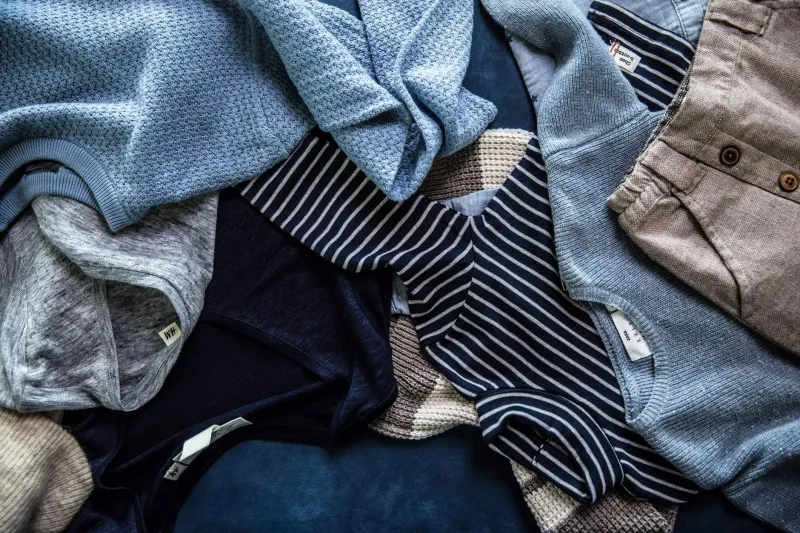
The single most useful decision in a hybrid capsule is fabric. A fine-gauge merino jumper reads as smart on camera and remains comfortable through a long morning at a desk. A cotton poplin shirt is crisp under a jacket but creases less than linen. A wool-blend trouser holds its shape on a train and does not feel restrictive when sitting for hours.
Avoid fabrics that require ironing before every wear, and avoid those that show every crease after twenty minutes. The middle ground — merino, cotton twill, ponte, fine corduroy — is where a hybrid wardrobe lives.
Colour matters less than texture, but it is not irrelevant. A palette of navy, grey, cream and one muted accent will mix reliably, and it photographs well on video calls, where strong patterns can shimmer or blur.
The core pieces
A workable hybrid capsule can be built from a modest number of items:
- Two pairs of trousers: one tailored wool blend, one dark denim or cotton twill.
- Three tops: a fine merino crew, a cotton shirt, a knit polo or long-sleeved T-shirt in a heavier weight.
- One unstructured jacket or overshirt: soft-shouldered, in navy or grey, suitable for both the office and the camera.
- One cardigan or fine knit layer for home days.
- One pair of leather trainers or loafers that work with both trousers.
This is not a prescriptive list. It is a demonstration that the middle ground is narrower than it appears. Most people need fewer pieces than they expect, provided those pieces are chosen for the transitions rather than for a single setting.
A weekly uniform formula
Decision fatigue is the quiet cost of hybrid working. A simple formula removes it. The following is a template, not a rule:
Monday: tailored trousers, merino crew, unstructured jacket. Tuesday in the office: shirt, tailored trousers, jacket; knit polo underneath if cold. Wednesday: dark denim, knit polo, cardigan. Thursday at home: tailored trousers or dark denim, shirt or merino, cardigan; jacket on the back of the chair for calls. Friday: whichever combination has been least worn that week.
The formula works because it treats the week as a rotation rather than a series of separate outfits. Each piece appears two or three times, in different combinations, and the wardrobe stays small enough to see at a glance.
Dressing for the lens
Video calls impose their own dress code, which is less formal than an office and more formal than a kitchen. The camera crops at the chest and shoulders, so collar shape and neckline matter more than trousers. A shirt with a structured collar, a merino crew with a clean neckline, or a knit polo will all read well; a hoodie will not, unless the culture explicitly permits it.
Lighting and background also affect how clothes read. A dark navy or grey top against a pale wall is reliable; an all-cream outfit can wash out; a busy print can distract. None of this requires new purchases. It requires choosing, from the existing capsule, the pieces that work on screen.
Care, rotation and the end of decision fatigue
A hybrid capsule is only useful if it is maintained. Rotate pieces deliberately, air knitwear between wears, and wash less often than instinct suggests. Merino and wool blends benefit from rest; cotton shirts benefit from hanging rather than folding.
The broader point is that a small wardrobe, chosen for transitions, reduces the number of decisions a working week demands. The aim is not to look identical every day, but to remove the morning question of whether an outfit is appropriate for the setting. When the answer is built into the wardrobe, the question disappears.
Hybrid working is unlikely to resolve into a single pattern. Weeks will continue to vary, and offices will continue to be inconsistent about heating. A capsule built around layers, calm fabrics and a simple rotation is not a solution to that variability. It is a way of absorbing it — quietly, and without adding another category of clothing to the wardrobe.